Ruliology is taking off! And more and more people are talking about it. But what is ruliology? Since I invented the term, I decided I should write something to explain it. But then I realized: I actually already wrote something back in 2021 when I first invented the term. What I wrote back then was part of something longer. But here now is the part that explains ruliology:
If one sets up a system to follow a particular set of simple rules, what will the system do? Or, put another way, how do all those simple programs out there in the computational universe of possible programs behave?
These are pure, abstract questions of basic science. They’re questions one’s led to ask when one’s operating in the computational paradigm that I describe in A New Kind of Science. But at some level they’re questions about the specific science of what abstract rules (that we can describe as programs) do.
What is that science? It’s not computer science, because that would be about programs we construct for particular purposes, rather than ones that are just “out there in the wilds of the computational universe”. It’s not (as such) mathematics, because it’s all about “seeing what rules do” rather than finding frameworks in which things can be proved. And in the end, it’s clear it’s actually a new science—that’s rich and broad, and that I, at least, have had the pleasure of practicing for forty years.
But what should this science be called? I’ve wondered about this for decades. I’ve filled so many pages with possible names. Could it be based on Greek or Latin words associated with rules? Those are arch- and reg-: very well-trafficked roots. What about words associated with computation? That’d be logis- or calc-. None of these seem to work. But—in something akin to the process of metamodeling—we can ask: What is the essence of what we want to communicate in the word?
It’s all about studying rules, and what their consequences are. So why not the simple and obvious “ruliology”? Yes, it’s a new and slightly unusual-sounding word. But I think it does well at communicating what this science that I’ve enjoyed for so long is about. And I, for one, will be pleased to call myself a “ruliologist”.
But what is ruliology really about? It’s a pure, basic science—and a very clean and precise one. It’s about setting up abstract rules, and then seeing what they do. There’s no “wiggle room”. No issue with “reproducibility”. You run a rule, and it does what it does. The same every time.
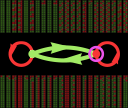
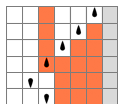
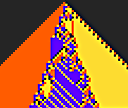
What does the rule 73 cellular automaton starting from a single black cell do? What does some particular Turing machine do? What about some particular multiway string substitution system? These are specific questions of ruliology.
At first you might just do the computation, and visualize the result. But maybe you notice some particular feature. And then you can use whatever methods it takes to get a specific ruliological result—and to establish, for example, that in the rule 73 pattern, black cells appear only in odd-length blocks.
Ruliology tends to start with specific cases of specific rules. But then it generalizes, looking at broader ranges of cases for a particular rule, or whole classes of rules. And it always has concrete things to do—visualizing behavior, measuring specific features, and so on.
But ruliology quickly comes face to face with computational irreducibility. What does some particular case of some particular rule eventually do? That may require an irreducible amount of computational effort to find out—and if one insists on knowing what amounts to a general truly infinite-time result, it may be formally undecidable. It’s the same story with looking at different cases of a rule, or different rules. Is there any case that does this? Or any rule that does it?
What’s remarkable to me—even after 40 years of ruliology—is how many surprises there end up being. You have some particular kind of rule. And it looks as if it’s only going to behave in some particular way. But no, eventually you find a case where it does something completely different, and unexpected. And, yes, this is in effect computational irreducibility reaching into what one’s seeing.
Sometimes I’ve thought of ruliology as being at first a bit like natural history. You’re exploring the world of simple programs, finding what strange creatures exist in it—and capturing them for study. (And, yes, in actual biological natural history, the diversity of what one sees is presumably at its core exactly the same computational phenomenon we see in abstract ruliology.)
So how does ruliology relate to complexity? It’s a core part—and in fact the most fundamental part—of studying the foundations of complexity. Ruliology is like studying complexity at its ultimate source. And about seeing just how complexity is generated from its simplest origins.
Ruliology is what builds raw material—and intuition—for making models. It’s what shows us what’s possible in the computational universe, and what we can use to model—and understand—the systems we study.
In metamodeling we’re going from models that have been constructed, and drilling down to see what’s underneath them. In ruliology we’re in a sense going the other way, building up from the minimal foundations to see what can happen.
In some ways, ruliology is like natural science. It’s taking the computational universe as an abstracted analog of nature, and studying how things work in it. But in other ways, ruliology is something more generative than natural science: because within the science itself, it’s thinking not only about what is, but also about what can abstractly be generated.
Ruliology in some ways starts as an experimental science, and in some ways is abstract and theoretical from the beginning. It’s experimental because it’s often concerned with just running simple programs and seeing what they do (and in general, computational irreducibility suggests you often can’t do better). But it’s abstract and theoretical in the sense that what’s being run is not some actual thing in the natural world, with all its details and approximations, but something completely precise, defined and computational.
Like natural science, ruliology starts from observations—but then builds up to theories and principles. Long ago I found a simple classification of cellular automata (starting from random initial conditions)—somehow reminiscent of identifying solids, liquids and gases, or different kingdoms of organisms. But beyond such classifications, there are also much broader principles—with the most important, I believe, being the Principle of Computational Equivalence.
The everyday course of doing ruliology doesn’t require engaging directly with the whole Principle of Computational Equivalence. But throughout ruliology, the principle is crucial in guiding intuition, and having an idea of what to expect. And, by the way, it’s from ruliology that we can get evidence (like the universality of rule 110, and of the 2,3 Turing machine) for the broad validity of the principle.
I’ve been doing ruliology (though not by that name) for forty years. And I’ve done a lot of it. In fact, it’s probably been my top methodology in everything I’ve done in science. It’s what led me to understand the origins of complexity, first in cellular automata. It’s what led me to formulate the general ideas in A New Kind of Science. And it’s what gave me the intuition and impetus to launch our new Physics Project.
I find ruliology deeply elegant, and satisfying. There’s something very aesthetic—at least to me—about the purity of just seeing what simple rules do. (And it doesn’t hurt that they often make very pleasing images.) It’s also satisfying when one can go from so little and get so much—and do so automatically, just by running something on a computer.
And as well I like the fundamental permanence of ruliology. If one’s dealing with the simplest rules of some type, they’re going to be foundational not only now, but forever. It’s like simple mathematical constructs—like the icosahedron. There were icosahedral dice in ancient Egypt. But when we find them today, their shapes still seem completely modern—because the icosahedron is something fundamental and timeless. Just like the rule 30 pattern or countless other discoveries in ruliology.
In a sense perhaps one of the biggest surprises is that ruliology is such a comparatively new activity. But as I cataloged in A New Kind of Science, it has precursors going back hundreds and perhaps thousands of years. But without the whole paradigm of A New Kind of Science, there wasn’t a context to understand why ruliology is so significant.
So what constitutes a good piece of ruliology? I think it’s all about simplicity and minimality. The best ruliology happens after metamodeling is finished—and one’s really dealing with the simplest, most minimal class of rules of some particular type. In my efforts to do ruliology, for example in A New Kind of Science, I like to be able to “explain” the rules I’m using just by an explicit diagram, if possible with no words needed.
Then it’s important to show what the rules do—as explicitly as possible. Sometimes—as in cellular automata—there’s a very obvious visual representation that can be used. But in other cases it’s important to do the work to find some scheme for visualization that’s as explicit as possible, and that both shows the whole of what’s going on and doesn’t introduce distracting or arbitrary additional elements.
It’s amazing how often in doing ruliology I’ll end up making an array of thumbnail images of how certain rules behave. And, again, the explicitness of this is important. Yes, one often wants to do various kinds of filtering, say of rules. But in the end I’ve found that one needs to just look at what happens. Because that’s the only way to successfully notice the unexpected, and to get a sense of the irreducible complexity of what’s out there in the computational universe of possible rules.
When I see papers that report what amounts to ruliology, I always like it when there are explicit pictures. I’m disappointed if all I see are formal definitions, or plots with curves on them. It’s an inevitable consequence of computational irreducibility that in doing good ruliology, one has to look at things more explicitly.
One of the great things about ruliology as a field of study is how easy it is to explore new territory. The computational universe contains an infinite number of possible rules. And even among ones that one might consider “simple”, there are inevitably astronomically many on any human scale. But, OK, if one explores some particular ruliological system, what of it?
It’s a bit like chemistry where one explores properties of some particular molecule. Exploring some particular class of rules, you may be lucky enough to come upon some new phenomenon, or understand some new general principle. But what you know you’ll be doing is systematically adding to the body of knowledge in ruliology.
Why is that important? For a start, ruliology is what provides the raw material for making models, so you’re in effect creating a template for some potential future model. And in addition, when it comes to technology, an important approach that I’ve discussed (and used) quite extensively involves “mining” the computational universe for “technologically useful” programs. And good ruliology is crucial in helping to make that feasible.
It’s a bit like creating technology in the physical universe. It was crucial, for example, that good physics and chemistry had been done on liquid crystals. Because that’s what allowed them to be identified—and used—in making displays.
Beyond its “pragmatic” value for models and for technology, another thing ruliology does is to provide “empirical raw material” for making broader theories about the computational universe. When I discovered the Principle of Computational Equivalence, it was as a result of several years of detailed ruliology on particular types of rules. And good ruliology is what prepares and catalogs examples from which theoretical advances can be made.
It’s worth mentioning that there’s a certain tendency to want to “nail down ruliology” using, for example, mathematics. And sometimes it’s possible to derive a nice summary of ruliological results using, say, some piece of discrete mathematics. But it’s remarkable how quickly the mathematics tends to get out of hand, with even a very simple rule having behavior that can only be captured by large amounts of obscure mathematics. But of course that’s in a sense just computational irreducibility rearing its head. And showing that mathematics is not the methodology to use—and that instead something new is needed. Which is precisely where ruliology comes in.
I’ve spent many years defining the character and subject matter of what I’m now calling ruliology. But there’s something else I’ve done too, which is to build a large tower of practical technology for actually doing ruliology. It’s taken more than forty years to build up to what’s now the full-scale computational language that is the Wolfram Language. But all that time, I was using what we were building to do ruliology.
The Wolfram Language is great and important for many things. But when it comes to ruliology, it’s simply a perfect fit. Of course it’s got lots of relevant built-in features. Like visualization, graph manipulation, etc., as well as immediate support for systems like cellular automata, substitution systems and Turing machines. But what’s even more important is that its fundamental symbolic structure gives it an explicit way to represent—and run—essentially any computational rule.
In doing practical ruliological explorations—and for example searching the computational universe—it’s also useful to have immediate support for things like parallel computation. But another crucial aspect of the Wolfram Language for doing practical ruliology is the concept of notebooks and computable documents. Notebooks let one organize both the process of research and the presentation of its results.
I’ve been accumulating research notebooks about ruliology for more than 30 years now—with textual notes, images of behavior, and code. And it’s a great thing. Because the stability of the Wolfram Language (and its notebook format) means that I can immediately go back to something I did 30 years ago, run the code, and build on it. And when it comes to presenting results, I can do it as a computational essay, created in a notebook—in which the task of exposition is shared between text, pictures and computational language code.
In a traditional technical paper based on the mathematical paradigm, the formal part of the presentation will normally use mathematical notation. But for ruliology (as for “computational X” fields) what one needs instead is computational notation, or rather computational language—which is exactly what the Wolfram Language provides. And in a good piece of ruliology—and ruliology presentation—the notation should be simple, clear and elegant. And because it’s in computational language, it’s not just something people read; it’s also something that can immediately be executed or integrated somewhere else.
 What should the future of ruliology be? It’s a huge, wide-open field. In which there are many careers to be made, and immense numbers of papers and theses and books that can be written—that will build up a body of knowledge that advances not just the pure, basic science of the computational universe but also all the science and technology that flows from it.